LANGTANG GOSAINKUNDA TREK
2(Min) -12(Max)
4610m
sep-nov
Overview
Langtang Gosaikunda Trek is a well-known trekking destination that is tucked between the main Himalayan range to the north and a comparatively lower range of snowy peaks to the south. For those who want to explore the mid-hills and high-altitude lakes, including the respected Gosainkunda Lake and other Himalayan glaciers, it is one of the most well-liked tourist destinations in the Langtang National Park. The trekking area is located not far north of Kathmandu, close to the Nepal-Tibet border. Despite the valley’s proximity to Kathmandu city, modernization hasn’t had much of an impact on its inhabitants.
This adventure gives you the chance to explore both the magnificent Alpine vistas and the rural traditions and culture of the inhabitants. Some of the trail’s prominent attractions include the Rhododendron and Bamboo Forests, which provide abundant wildlife habitat, gorgeous waterfalls that cascade over Mammoth Boulders, and calming hot spring retreats.
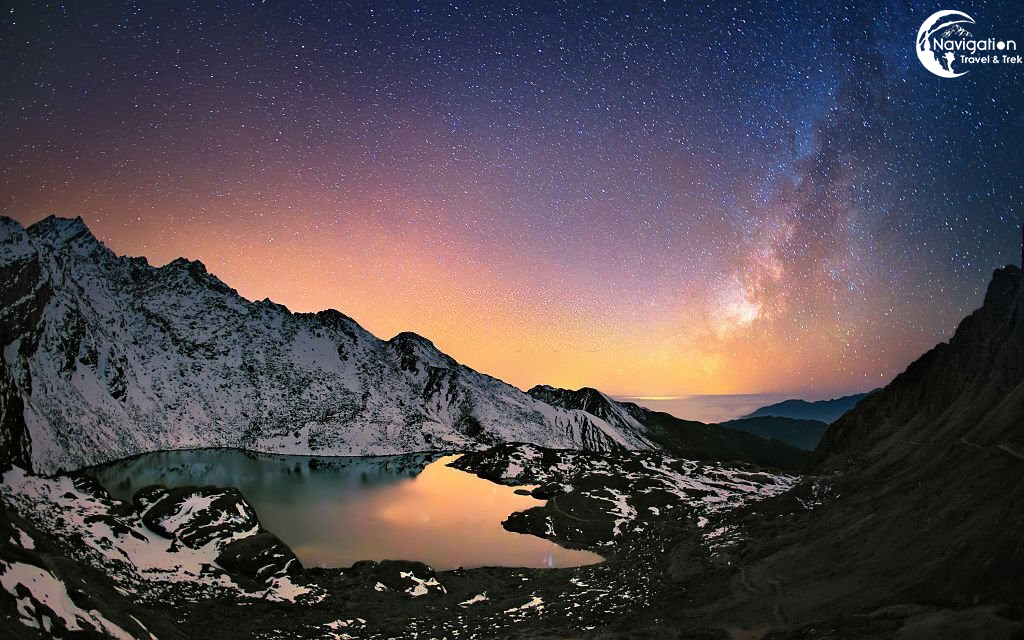
You will have numerous opportunities to take in the panoramic magnificence of the Langtang and Ganesh Himalayan Ranges during this journey. Scared Gosainkunda (4,380m/14,620ft), an alpine freshwater lake located in the Rasuwa Mountains, is the major destination of this journey.
Itinerary
From Kathmandu, we will travel 117 kilometers (7 hours) to Syabru Besi. The road is winding, mostly unpaved, and located in the mountains. Roaring rivers, terraced farms, typical Nepali villages, and snow-capped peaks may all be observed from the route. Driving to Syabru Besi from Dhunche will take us through picturesque foothills and ridgeline scenery. Syabru Besi is a bustling market town with a lot to discover, including relaxing riverfront hot springs. You can admire the glimpse of terraces, green hills and Ganesh Himal from Syabrubesi.
 Destination
Syabrubesi

Lodge

Lunch, Dinner

1503m

8hr
After breakfast, we began our 11.3-kilometre journey to Lama Hotel from Syabrubesi (7 miles). After climbing a hill and crossing the Bhote Koshi River, the trip continues along the Langtang River through a lush jungle and terraced fields, where a perfect vista of waterfalls is revealed. We move past the landslide region up ahead, climb to Bamboo, and then steadily ascend to Rimche, which is situated along the Langtang Riverbank. The trials today treat you with the spectacular vista and rich culture plus the lifestyle of the mountain people. To get there, you have to pass across several streams and cross them while admiring the falling waterfalls. You might also see stunning rhododendron and oak forests, as well as wildlife like red pandas, Himalayan black bears, wild boars, langurs, and throated martins.
Destination
Lama Hotel
Lodge
Breakfast, Lunch, Dinner
2470m
6hr
We will hike through breathtakingly gorgeous paths on the journey from the Lama Hotel to Langtang. The walk today is simpler than the previous day because of the short ascent on the route. After breakfast, we continue our trek through the lush jungle as we follow the Langtang River. Exotic scenery may be seen from Langtang Li rung. At 3000 meters, we will come across the lovely GhodaTabela meadow. We will halt at the GhodaTabela army checkpoint to register our paperwork. Heading on, we pass through prayer flags and prayer wheels driven by flowing water before arriving at the picturesque Tamang village of Langtang. Along the way, we passed through several kinds of wood and witnessed astonishing waterfalls on the Kangjala and Langtang ranges.
Destination
Langtang Village
Lodge
Breakfast, Lunch, Dinner
3430m
6hr
From Langtang to Kyanjin Gompa, it will take us around 3900 meters of trekking. The largest mani wall in Nepal, which is composed of stone with prayers engraved on it, will be observed when we are trekking. The enormous Langtang valley offers a spectacular view of the gigantic Himalayas. We travel through a glacier moraine and various tributaries. Finally, we reach Kyanjin Gompa, a place called after the nearby, historic monastery of Kyanjin Gompa, which was formerly the greatest settlement of Kyanjin. Kyanjin Gompa is bordered by the Himalayas and offers breathtaking views of glaciers, icefalls, birds, and yaks, including Kyanjin Ri (4750 m), Tsergo Ri (5000 m), Ganja La (5160 m), Langshisha- Ri (6427 m), Dorje Lhakpa (6430 m), Naya Kang (5844 m), and Yala Peak (5500 m), among others.
Destination
Kyanjin Gompa
Lodge
Breakfast, Lunch, Dinner
3865m
3hr
On this day, we will stay at Kyanjin Gompa to adapt to the high mountain elevation. Beautiful up-close views of the tall mountains and glaciers can be encountered in the upper Langtang Valley. For stunning mountain vistas of the Himalayan peaks, including Langtang Li rung (7,227m), Langtang II (6,59m), Ganesh Himal (7406m), Naya kanga (5846m), and Yala peak (5,500m), we can hike up to Kyanjin Ri or Tseku Ri. We’ll also be visiting several sites, such as the Kyanjin Gompa Monastery and the Yak Cheese Factory. Throughout the day you will be able to capture the tranquil natural beauty that enfolds the Langtang region throughout the day, encasing its spiritual significance.
Destination
Kyanjin Gompa
Lodge
Breakfast, Lunch, Dinner
3865m
2hr
We bid farewell to the upper highlands from Kyanjin Gomba and begin descending on a trail that will take us out of the valley. We proceed along the same route that led us to Kyanjin Gomba. We will pass ethnic Tamang settlements along the way, whose cultural and religious beliefs are identical to those of the Tibetans, before stopping for lunch at Ghoda Tabela where we register the departure at the army checkpoint. We descend to Lama Hotel after a leisurely lunch via the river valley’s dense woodlands.
Destination
Lama Hotel
Lodge
Breakfast, Lunch, Dinner
2470m
6hr
Like every other day, the trip to Thulo Syabru from the Lama Hotel begins. Crossing a small waterfall, the trail descends to the banks of the Langtang Khola. The route will lead us through a bamboo and rhododendron forest that is filled with animals like wild boar and monkeys. As you head down, you might run into a flock of goats that are grazing on the land. The trail’s upper section is more attractive since it provides a panoramic scenery of the mountains and lush hills. At the end of this day’s trek, we will cross a suspension bridge to reach the bottom of the Thulo Syabru village. This region is dominated by the Tamang community who have assimilated the Tibetan way of life.
Destination
Thulo Syabru
Lodge
Breakfast, Lunch, Dinner
2210m
7hr
The Langtang Valley trek typically ends in Syabru village, but since we are preparing for the trek to Gosaikunda, we need to head toward Cholangpati. From Thulo Syabru, we progressively ascend while passing the army checkpoint in Langtang National Park. After a 30-minute climb, we arrive in Daragang. The path travels through a thick hemlock and oak tree forest where you might witness the endangered red panda. After a short elevation and light tree side, we will reach Dhimsa, followed by Shing Gompa.
Destination
Cholangpati
Lodge
Breakfast, Lunch, Dinner
3654m
6hr
Another great day of hiking awaits us as we make our way to the stunning Gosainkunda Lake. Cholangpati to Gosaikunda Lake is a short and comparatively simple trek. The picturesque Langtang Himal (7234 m), the most well-known peak in the entire Langtang Range, will welcome you as you climb. As we start walking on a desolate barren mountain trail, more mountains will become viewable, including the magnificent Langtang Himal, Ganesh Himal, and even the Annapurna’s on the western horizon.
The waterfall and lakes- Saraswati Kunda and Bhairav Kunda, which are both formed by water running from Gosainkunda, are then noticeable after climbing steeply forward, passing a few high fields. According to tradition, Shiva created Gosainkunda when he used his trident to pierce a glacier to get water to satisfy his thirst after ingesting a poison that threatened to doom the world. The Hindus and Buddhists regard this lake as one of their most sacred lakes. Each year, hundreds of pilgrims visit Gosaikunda for a religious Hindu festival.
Destination
Gosainkunda Lake
Lodge
Breakfast, Lunch, Dinner
4380m
5hr
We will travel via the Laurebina La High Pass today to reach the picturesque Helambu region. The path initially descends from the lodges to Gosainkunda Lake from there. Then, as we move closer to the Laurebina La Pass, the northern bank of our trek becomes steeper. However, you will first pass three or more tiny lakes as you make your way toward this pass.
A large stone stupa and numerous prayer flags serve as markers for the Laurebina La Pass. For the Langtang Trek, this pass represents its highest point. After reaching High Camp (4240 m), we descend through a broad valley and continue to Phedi on steeper, rocky terrain. We descend to a bridge over a stream right after Phedi. Long ascents make the trip from Phedi to Ghopte challenging.
Destination
Ghopte(Laurebina Pass)
Lodge
Breakfast, Lunch, Dinner
4610m
9hr
We will set off for Kutumsang on a path that gently descends through a juniper, rhododendron, and pine forest on the western slope of a ridge. Before arriving at the serene highland location of Tharepati, we ascend through the dense jungle in a remote, unpopulated area. From Tharepati, the path slowly descends through the forest on the western ridge slope.
After a short walk, we come across a wider meadow with abandoned shepherd houses before descending to Magin Goth (3265m). Peaks like Gangchempo and Dorje Lakpa are visible from the route. A quick stroll passing through Kyuola Bhanjyang (3335m) will lead us to a rhododendron woodland.
Destination
Kutumsang
Lodge
Breakfast, Lunch, Dinner
2470m
5hr
From Kutumsang, we will climb for a while before descending to the village of Gul Bhanjyang (2140m). The path continues on a rocky, steep path via Thorong Danda(2500m) to the Chipling settlement. We continue on a wide trail to Pati Bhanjyang (1760m), a small town situated between Chipling and Chisopani. From here, it takes us 30 minutes of walking to get to Chisopani, which is renowned for its breathtaking panoramas of several mountains.
Destination
Chisopani
Lodge
Breakfast, Lunch, Dinner
2295m
5hr
It should take roughly 4-5 hours to get from Chisopani to Sundari Jal. We take a short distance to walk from Chisopani to the Shivpuri National Park checkpoint. From here, we travel on a broad road that descends a hill before ascending it on a paved route. After passing a few water reservoirs and substantial water pipes, we eventually arrive at Sundari Jal (1460m). From there, we have a clear view of the Langtang and Ganesh Himal Himalayan mountains. Sundari Jal is the perfect location for a picnic because of its stunning waterfalls, cascades, and rock formations.
Destination
Kathmandu
Breakfast, Lunch
1400m
6hr
Altitude Graph
Inclusion/Exclusion
The Cost Includes
- Three meals a day during the Trekking (Breakfast, Lunch and Dinner).
- Accommodations in Tea House/Lodge during the Trekking.
- Pokhara-Kathmandu flight costs (includes tax and government fees).
- Kathmandu to Syabrubesi (trek start) and Sundari Jal back to Kathmandu (trek end) by private vehicle.
- Trekking Guide, assistant trekking guide for groups with 12 or more trekkers and a porter (Sharing by two clients) with Insurance, food, and accommodations.
- Langtang National Park entry permit fee.
- Snacks (cookies) and seasonal fresh fruits every day.
- Rescue operation arrangement in case of complicated health conditions (funded by travel insurance).
- Proper First aid kit.
- A TIMS card (Trekking Information Management System) is like a permit.
- All government, local taxes, and official expenses.
- Company’s duffel bag will also be provided. (If needed).
- All essential official fees.
Service not included in the Price
- International flight cost.
- Your travel insurance.
- Excess baggage charge (weight limit 9 kg per person).
- On arrival visa fees at Tribhuvan International Airport (30 days- USD 50).
- All accommodations and meals in Kathmandu, before and after the trek
- Extra night accommodations in Kathmandu due to early arrival, late departure, or early return from the trek.
- Personal expenses (shopping, snacks, boiled water, hot (tea/coffee) and cold drinks, hot shower, alcohol, Wi-Fi, telephone call, battery re-charge fee, extra porters, etc.
- Tips for the Guide and Porter(expected).
- Travel insurance that covers emergency high-altitude Heli – rescue and evacuation and health care costs (compulsory).
- Additional costs or delays due to circumstances beyond our control like bad weather conditions, itinerary modification for safety, government policy changes.
Useful Info
When planning a trek to Langtang Gosaikunda, the weather is the most important factor to take into account. The finest seasons for an easy hike with stunning mountain views are spring and fall. The trek regions are cold in the winter because of snowfall, and they become muddy and sloppy in the summer because of monsoon rains.
March – April
One of the greatest seasons to trek to the Langtang and Gosaikunda is from March to April. You could see the spectacular scenery of Langtang Lirung, Langtang II, and other summits with top-notch climates. Since mid-March, when temperatures begin to rise, many trekkers choose to travel to the Langtang Gosainkunda region. The lush green, dense bamboo and birch forests give the entire trek experience a new dimension.
May-June
Right before the monsoon, May and June are also considered ideal seasons for trekking around the Langtang region. In Nepal, the rainy season starts at the end of June and lasts until mid-August. The journey is far more pleasurable throughout the spring and summer.
July – August
During this season, rainfall is at its heaviest, and clouds are frequently visible. Due to the stunning waterfalls, roaring rivers, and frequent rainbows, trekking may still be enjoyable even when the trails become a little slippery and challenging compared to other seasons.
September – October
The Langtang Gosaikunda trek is also regarded to be best in September and October. The monsoon gradually ends, offering the ideal weather for trekking. During the day, it gets as high as 20 degrees, while at night, it gets as low as 5. Most hikers find these months to be the most delightful because the sky is clear and the mountains are easy to witness, giving them a gorgeous sight of the Himalayan range, landscape, dense forest and many more.
November – December
The winter sets in, and snowfalls begin in the Langtang region, eventually making it challenging to trek. However, you can trek during November, thanks to the sparkling days. With clear skies, the mountains look stunning, but as December starts, the temperatures dip. The nights can get cold with temperatures as low as -5 degrees Celsius.
January – February
Snow starts to fall in the Langtang region as winter approaches, finally making the trek from January to February a little challenging. However, because of the wonderful days in November, you can go trekking. The mountains are captivating when the skies are clear during November, but when December gets underway, the temperatures drop to -5 degrees Celsius.
Send Request
You can send your enquiry via the form below.
Trip name: * LANGTANG GOSAINKUNDA TREK